Main Points Summary: The question of when to introduce an addition calculator in the classroom is one of the most debated topics in modern elementary education. Proper timing is essential because it directly influences student math fluency, long-term arithmetic retention, and the development of independent problem-solving skills. Math learning tools, when introduced thoughtfully, can dramatically improve classroom engagement and reduce math anxiety. However, premature reliance on digital aids may weaken basic arithmetic development if students have not yet built a solid mental math foundation. Effective teaching strategies must balance the power of technology with the irreplaceable value of conceptual understanding.
Introduction
Early math education forms the backbone of a child’s entire academic journey. The skills children develop in their first years of schooling — counting, comparing quantities, understanding number relationships, and performing basic operations — do not just prepare them for advanced mathematics. They build the logical thinking, pattern recognition, and problem-solving capabilities that students will rely on across every subject and throughout their lives.
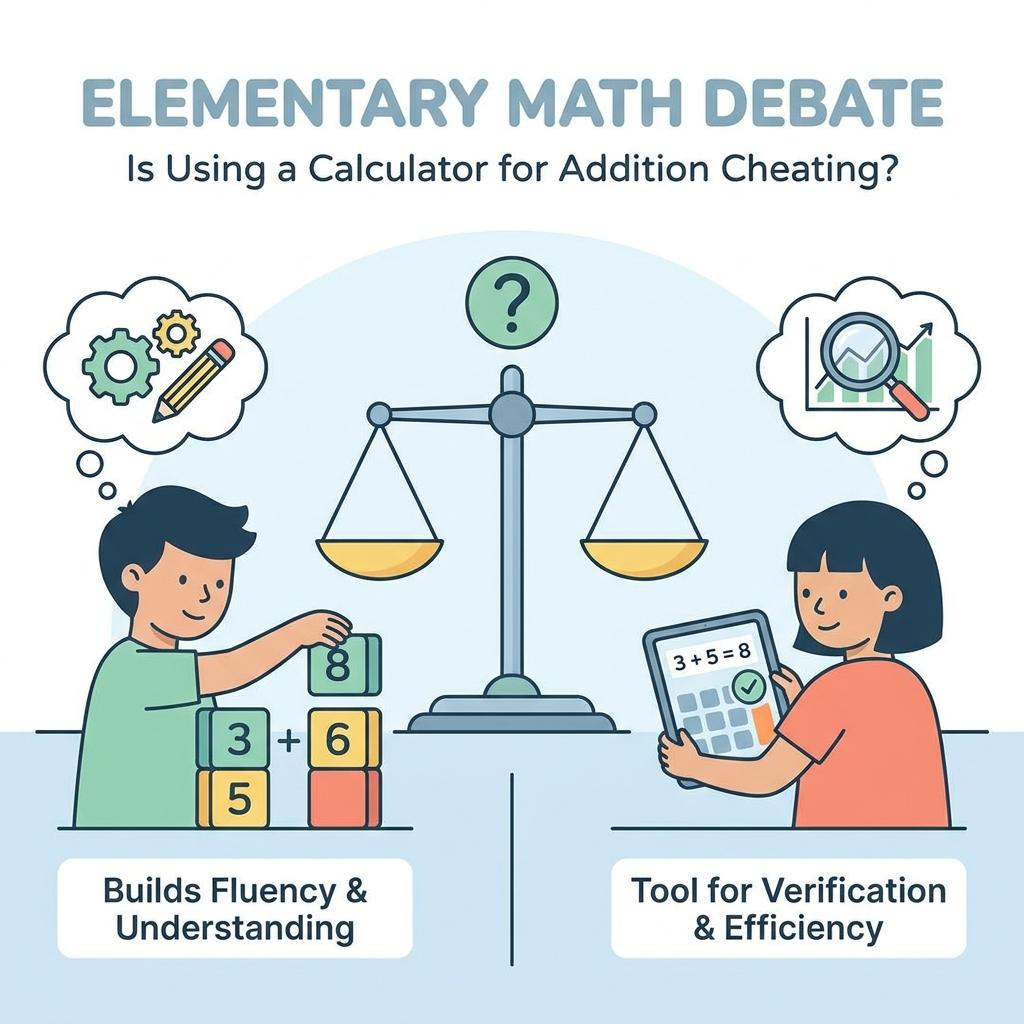
Modern classrooms have access to a wide and growing range of tools designed to support learning. From manipulatives like counting blocks and number lines to digital devices and software applications, today’s teachers have more resources than ever before. Among these, addition calculators occupy a particularly complex position. They are powerful, they are engaging, and they are undeniably useful — but only when introduced at the right moment in a child’s development.
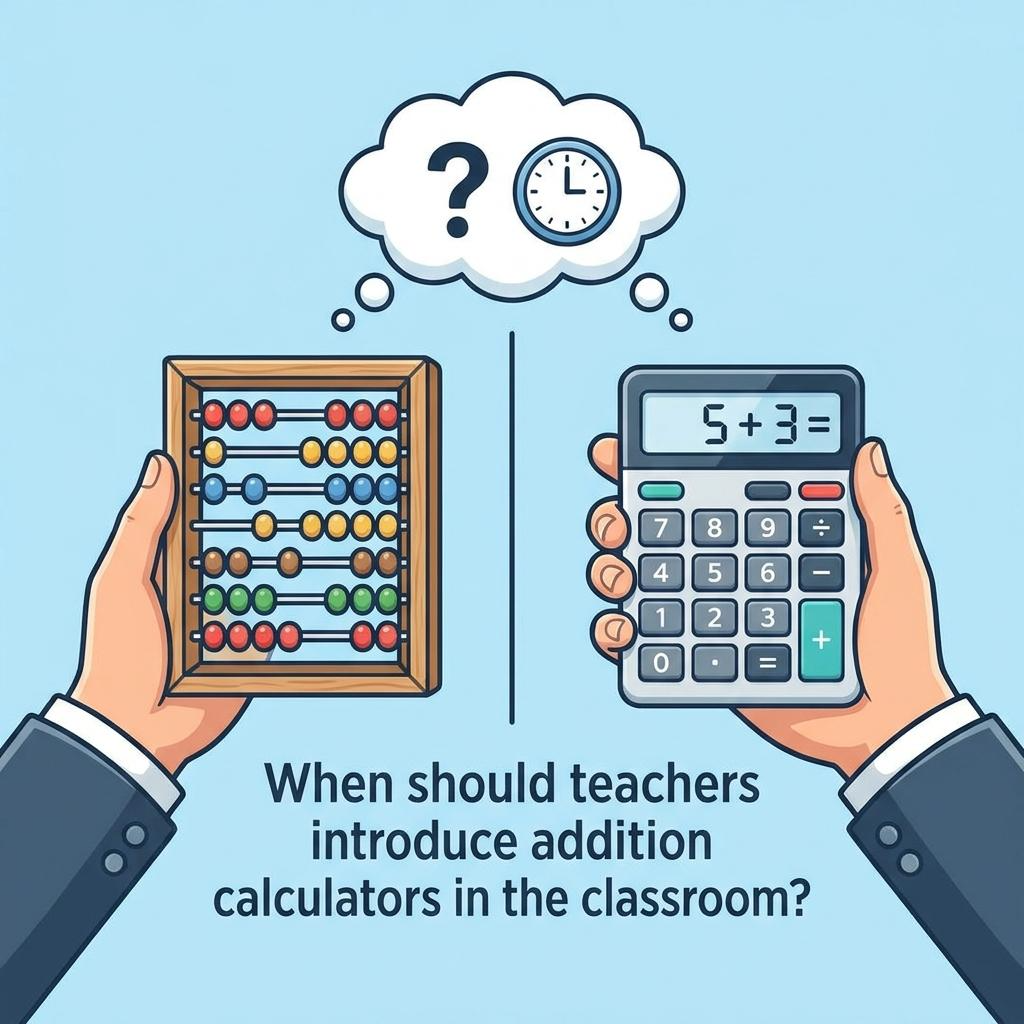
The timing of calculator introduction matters enormously. Introduce them too early, and students may never fully internalize the mental processes that underpin arithmetic fluency. Introduce them too late, and students may miss out on the confidence-building and engagement benefits these tools provide. The goal is to achieve a thoughtful balance between mental math and digital tools, ensuring that technology enhances understanding rather than replacing the thinking process altogether.
This blog explores the research, the best practices, and the practical strategies that help teachers make this critical decision wisely.
Understanding Math Learning Stages
Early Childhood Math Skills
Before any conversation about calculators can begin meaningfully, teachers and educators need to understand how mathematical thinking develops in children. Math cognition does not appear fully formed — it grows in stages, each one building upon the last.
In the earliest years, typically from birth through age five, children develop what researchers call number sense. This is the intuitive understanding that quantities exist, that they can be compared, and that they can change. A toddler who understands that three cookies are more than one cookie, or who notices that one toy is missing from a group, is already exercising primitive mathematical reasoning.
By the time children enter formal schooling at around five or six years of age, most have developed a functional understanding of counting, basic quantity comparison, and simple one-to-one correspondence. They can count objects physically, understand that seven is more than four, and begin to grasp that numbers follow a predictable sequence.
In grades one and two, children begin learning basic arithmetic operations — addition and subtraction — initially through physical manipulation of objects. Counting on fingers, using blocks, drawing dots, and using number lines are all developmentally appropriate strategies at this stage. These hands-on approaches are not primitive or childish; they are cognitively essential. They help children build the mental models that will eventually allow them to perform calculations entirely in their heads.
Development of Mental Arithmetic
Mental arithmetic is not simply the ability to calculate without writing anything down. It is a sophisticated cognitive skill that involves holding numbers in working memory, applying known strategies, and verifying results through logical reasoning. Developing this ability takes time, repetition, and practice.
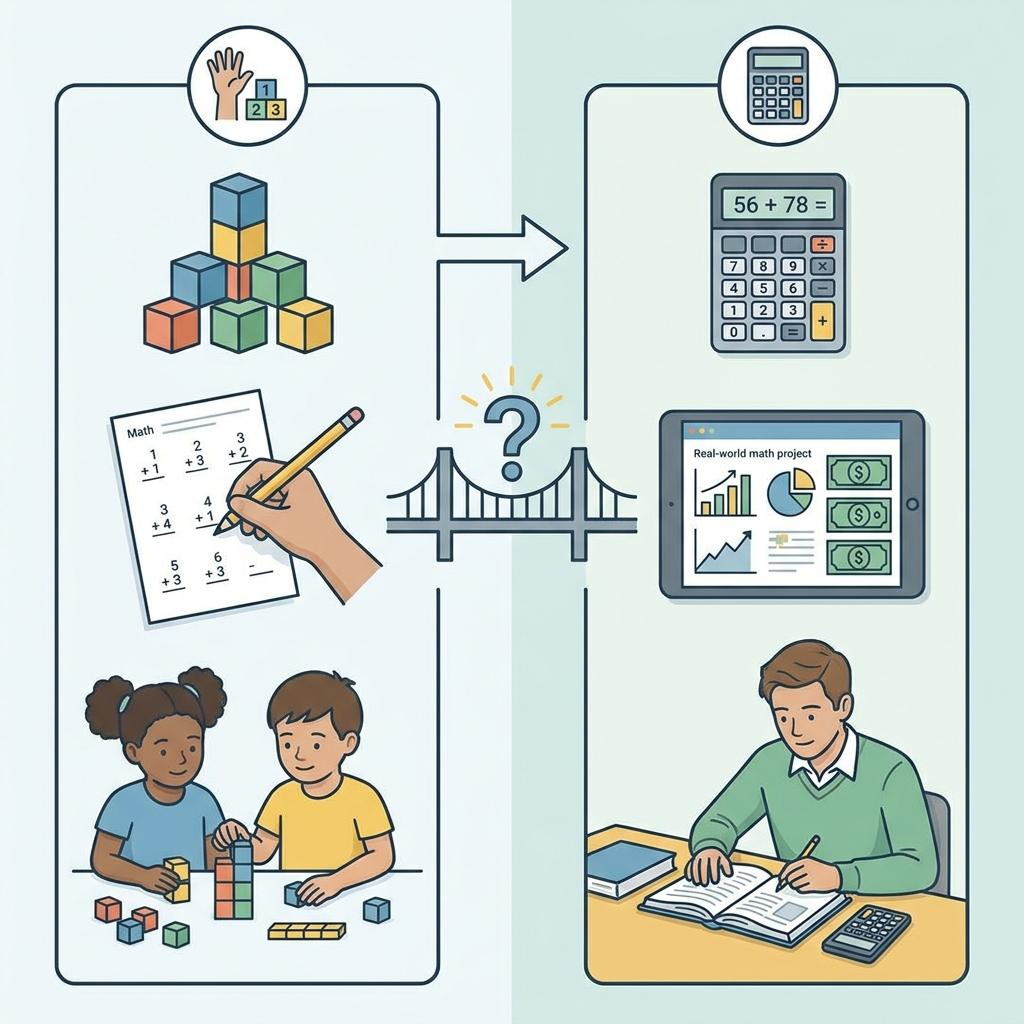
Children typically begin moving from concrete (physical) to representational (drawn or symbolic) to abstract (purely mental) mathematical thinking between the ages of six and nine. This progression — often described in educational theory as the Concrete-Pictorial-Abstract (CPA) model — is the foundation of almost all primary math curricula in high-performing education systems around the world.
During the mental arithmetic development phase, children learn critical strategies such as:
- Counting on from the larger number (rather than starting from one)
- Making tens (recognizing that 7 + 3 = 10 and using this to simplify larger additions)
- Doubles and near-doubles (knowing that 6 + 6 = 12 makes 6 + 7 easy)
- Decomposing numbers (breaking 8 + 5 into 8 + 2 + 3)
Each of these strategies represents a leap in abstract thinking. When students master them, they are not just faster at arithmetic — they understand the structure of the number system itself. This structural understanding is exactly what allows them to progress to multiplication, fractions, algebra, and beyond.
When Students Are Ready for Tools
Readiness for tools like calculators is not simply a matter of age. It is a matter of conceptual readiness — the point at which a student has internalized enough arithmetic understanding that a calculator becomes an extension of their thinking rather than a substitute for it.
A student who picks up a calculator and types 6 + 7 without understanding what addition means, or why the answer should be reasonable, is not being supported by the tool. They are being bypassed by it. The tool is doing the thinking, and the student is simply operating it.
In contrast, a student who understands that 6 + 7 should be slightly more than 12 (because they know their doubles), who can estimate the answer before calculating, and who uses the calculator to verify or to handle larger numbers efficiently — that student is using the tool as a genuine cognitive aid.
Signs that a student may be ready to begin using a calculator as a learning tool include:
- Consistent and accurate mental recall of basic single-digit addition facts
- Ability to estimate answers before calculating
- Understanding of what addition means conceptually (combining quantities)
- Confidence with two-digit addition using manual strategies
- The ability to recognize an obviously wrong calculator answer (e.g., knowing that 24 + 13 cannot equal 300)
Role of Addition Calculators in Education
How Calculators Support Learning
When introduced appropriately, addition calculators serve a powerful educational function. They remove the cognitive load of computation, allowing students to focus on higher-order mathematical concepts. This is especially valuable once students have already demonstrated mastery of the underlying arithmetic.
Consider a student who fully understands addition but is working on a word problem that involves multiple steps — identifying the relevant quantities, setting up the correct operation, interpreting the result in context, and communicating the answer clearly. If this student is slowed down by struggling to calculate 47 + 38, the calculator allows them to offload the mechanical step and focus their mental energy on the conceptual work.
This is not a shortcut. It is the same principle that allows adult professionals — engineers, scientists, accountants — to use calculators routinely without any suggestion that they do not understand math. The tool serves the thinking; the thinking is not replaced by the tool.
Calculators also serve an important diagnostic function in the classroom. When a teacher observes how a student uses a calculator — what they input, how they interpret the result, whether they question an unexpected answer — they gain valuable insight into that student’s mathematical understanding that might not be visible during written work alone.
Reinforcement of Basic Arithmetic
Counterintuitively, calculator use can actually reinforce basic arithmetic when structured correctly. Activities in which students predict an answer, then check with the calculator, then discuss why the answer matches or differs from their prediction, actively strengthen arithmetic fluency rather than undermining it.
This predict-calculate-reflect cycle engages students at a deeper level than simple repetitive drills. It introduces an element of metacognition — thinking about thinking — that is strongly associated with long-term retention and mathematical confidence.
Teachers can also use calculators to help students explore number patterns, such as what happens when you repeatedly add the same number (the foundation of multiplication), or what patterns emerge when adding even and odd numbers. These explorations are difficult to sustain through manual calculation alone, particularly for younger students who tire quickly. The calculator removes the fatigue barrier and allows the mathematical discovery to remain front and center.
Classroom Engagement Benefits
From a purely practical classroom management perspective, addition calculators increase engagement, particularly for students who struggle with math or who have developed a negative attitude toward arithmetic. For these students, the calculator can serve as a confidence bridge — a way of participating successfully in mathematical activity while their underlying fluency skills continue to develop.
Struggling students who are repeatedly asked to perform calculations they cannot complete accurately often disengage from math entirely. They learn to associate arithmetic with failure, frustration, and embarrassment. The calculator, introduced strategically, can interrupt this cycle by allowing these students to experience mathematical success and to remain participants in classroom learning.
Best Age or Grade to Introduce Calculators
Primary School Stage
The consensus among educational researchers and curriculum developers is that formal, structured introduction of calculators as a learning tool should generally not precede the end of second grade or the beginning of third grade — approximately ages seven to nine, depending on the child’s individual development.
By this point, most students have had significant exposure to and practice with basic addition and subtraction facts. They have typically been introduced to two-digit operations and are beginning to encounter problems complex enough that the calculator adds genuine value without replacing foundational learning.
It is important to note that this timeline refers to the use of calculators as a deliberate instructional tool, not as a free-use resource during all mathematical activity. Many classrooms allow calculators during specific activities long before making them a standard classroom fixture, and this graduated approach is generally considered best practice.
Transition Phase Considerations
The transition from purely manual arithmetic to calculator-assisted work is a critical phase that deserves deliberate planning. This transition typically occurs during grades three and four, as students move from mastering basic operations toward applying them in multi-step problems, measurement contexts, and early data work.
During this phase, teachers should actively monitor which students are using calculators as a crutch versus which are using them productively. Signs of unhealthy dependence include using the calculator for single-digit facts that should be automatic, being unable to estimate whether an answer is reasonable, and showing confusion when the calculator produces an unexpected result.
A student in healthy transition will use the calculator selectively, reserve it for complex calculations or verification purposes, and demonstrate clear understanding of what they are calculating and why.
Skill-Based Readiness vs Age
While age and grade provide useful general guidelines, skill-based readiness is ultimately a more reliable indicator than chronological age. Every classroom contains a range of mathematical abilities, and a one-size-fits-all approach to calculator introduction will not serve all students equally.
Teachers are encouraged to assess individual readiness using short, informal assessments that test:
- Recall of basic addition facts up to 20
- Ability to apply mental math strategies (not just recall memorized answers)
- Number estimation skills
- Understanding of what an unreasonable answer looks like
Students who demonstrate solid performance across these areas are genuinely ready for calculator integration. Those who are still developing these skills may benefit from continued hands-on and mental math work before the calculator is introduced, even if their peers have moved on.
Teacher Strategies for Introducing Calculators
Gradual Introduction Method
The gradual introduction method is widely recommended as the safest and most effective approach to incorporating calculators into primary classroom mathematics. Rather than placing calculators on desks and allowing open use, teachers introduce them as special tools for specific tasks.
The gradual method might look like this:
Phase 1 — Exploration: Students are given calculators to explore freely during a non-assessment period. They press buttons, discover how the display works, and familiarize themselves with the interface. This removes the novelty distraction that often interferes with focused learning when new tools are introduced.
Phase 2 — Guided Activities: Teachers introduce specific activities where the calculator plays a defined role — for example, checking answers after manual calculation, or exploring what happens when you add the same number repeatedly.
Phase 3 — Selective Use: Students are taught explicitly when calculators are appropriate and when they are not. This involves direct conversation about the purpose of the tool and the importance of maintaining mental math skills.
Phase 4 — Integrated Use: Calculators become one of several tools available for appropriate tasks, used alongside number lines, mental strategies, and written algorithms.
Combining Mental Math with Calculator Use
The most effective classroom approaches do not treat mental math and calculator use as competing alternatives. Instead, they integrate both within the same activity, making the relationship between estimation, mental calculation, and calculator verification explicit and purposeful.
One powerful technique is the estimate-then-calculate routine:
- Present a problem (e.g., 56 + 37)
- Ask students to estimate the answer using mental math (rounding to 60 + 40 = approximately 100)
- Students calculate the exact answer on the calculator (93)
- Students compare the actual result to their estimate and discuss whether it makes sense
- Teacher facilitates a discussion about why the estimate was close but not exact
This routine keeps mental math active and valued while legitimizing the calculator as a verification and precision tool. Over time, it also teaches students to be critical consumers of calculator outputs — an enormously important skill in a world where technology-generated errors are increasingly common.
Classroom Activities and Exercises
Practical activities that effectively integrate calculators into early math learning include:
Number Pattern Exploration: Students use calculators to investigate what happens when they repeatedly add 5, 10, or 25 to a starting number. This builds early multiplication intuition and number pattern recognition without requiring complex computation.
Calculator Relay Challenges: In pairs or small groups, one student calculates manually while another uses a calculator. They compare answers and discuss discrepancies. This gamifies the comparison between methods and keeps manual calculation valued and active.
Broken Key Problems: Students are told that a specific key on their calculator is “broken” (e.g., the 5 key) and must find ways to calculate problems that would normally require that digit. This forces flexible mathematical thinking and demonstrates that understanding arithmetic is more important than mechanical operation of a device.
Error Hunting: Teachers present intentionally incorrect calculator results and ask students to identify the error. This develops critical thinking, estimation skills, and the crucial habit of questioning technology-generated answers.
Benefits of Using Calculators at the Right Time
Improved Confidence
One of the most significant and often underestimated benefits of well-timed calculator introduction is the improvement in mathematical confidence it produces. Students who have previously struggled with computation — whether due to learning differences, slower processing speed, or limited fact fluency — often experience a meaningful boost in self-efficacy when given access to a calculator.
This confidence is not false or inflated. When a student who has understood a mathematical concept but been blocked by computational difficulty is finally able to produce correct answers consistently, they experience genuine mathematical success. This success is a legitimate foundation for growing confidence, and it can transform a student’s relationship with mathematics in ways that benefit them for years.
Math confidence is one of the strongest predictors of long-term mathematical engagement. Students who believe they are capable of mathematical thinking are far more likely to persist through difficulty, attempt challenging problems, and pursue mathematical learning beyond what is strictly required.
Reduced Math Anxiety
Math anxiety — the emotional distress that many people experience in mathematical situations — is a genuine and well-documented phenomenon that negatively impacts performance, reduces engagement, and can create lasting avoidance of mathematical topics. Research indicates that math anxiety often develops in the primary school years and is strongly associated with experiences of repeated failure or public difficulty with arithmetic.
The calculator, introduced thoughtfully, can serve as a powerful anxiety-reduction tool. By removing the threat of computational failure from activities focused on conceptual understanding, it allows anxious students to participate, experience success, and gradually rebuild a more positive relationship with mathematics.
Teachers should be aware, however, that calculator use alone does not address the root causes of math anxiety. It must be accompanied by a supportive classroom culture, clear communication about the purpose and limitations of the tool, and continued development of underlying arithmetic skills.
Better Understanding of Patterns
Calculators make it practical for students to explore mathematical patterns that would be too tedious to investigate through manual calculation alone. This exploratory capacity is genuinely valuable for mathematical development.
When students can quickly generate sequences, test conjectures, and observe regularities, they engage with mathematics as a system of discoverable rules rather than a set of arbitrary procedures to be memorized. This shift from memorization to pattern recognition is a hallmark of deep mathematical understanding and sets students up for success with algebra and beyond.
Risks of Introducing Too Early
Dependency on Tools
The most frequently cited risk of premature calculator introduction is the development of tool dependency — the inability or unwillingness to perform even simple calculations without technological assistance. This is not a theoretical concern; it is a pattern that has been observed by teachers in classrooms where calculators were made freely available before students had developed solid arithmetic foundations.
Students who become dependent on calculators often struggle significantly when they encounter situations where calculators are unavailable or inappropriate — during certain assessments, in real-world mental calculation scenarios, or in higher-level mathematics where the expectation is that basic arithmetic is automatic.
More troublingly, dependent students often cannot recognize obviously incorrect calculator outputs because they lack the number sense to judge whether an answer is reasonable. This makes them vulnerable to errors caused by typos, wrong operations, or misread displays — errors that a mathematically fluent student would catch immediately.
Weak Mental Calculation Skills
Mental calculation is not merely a backup system for when technology is unavailable. It is an active cognitive skill that builds working memory capacity, strengthens number sense, and develops the kind of flexible mathematical thinking that no calculator can replicate.
Research consistently shows that students with strong mental arithmetic skills outperform their peers not just in basic computation but across a wide range of mathematical tasks, including those where calculators are permitted. The relationship between mental math fluency and overall mathematical achievement is robust and has been replicated across multiple countries, curriculum systems, and age groups.
When students miss the developmental window for building strong mental arithmetic — whether due to early calculator dependence or other factors — they often carry this deficit forward. Remediation at later stages is possible but significantly harder than prevention through appropriate tool introduction timing.
Reduced Problem-Solving Ability
Perhaps the deepest risk of early calculator dependence is the impact on mathematical problem-solving ability. Problem-solving is not about calculation. It is about reading a situation, identifying the relevant mathematical structure, choosing appropriate operations, executing those operations correctly, and interpreting the result in context.
Students who have always relied on calculators for computation may develop a fundamentally passive relationship with numbers — they know how to input problems, but they have limited experience constructing mathematical approaches from scratch. This passivity is a significant disadvantage in the higher grades, where mathematical success depends increasingly on creative and flexible thinking rather than computational accuracy.
Balanced Teaching Approach
Hybrid Learning Model
The hybrid learning model represents the most widely endorsed approach among mathematics educators and curriculum developers. In this model, both mental arithmetic and calculator use are treated as valuable and complementary skills, each developed deliberately and used in contexts where they are most appropriate.
In a hybrid classroom, a typical week might include:
- Daily mental math warm-ups requiring no tools of any kind
- Collaborative problem-solving activities where calculators are available for complex calculations
- Individual practice sessions focused on arithmetic fluency building
- Exploratory activities where calculators enable mathematical investigation at a level beyond what manual computation would allow
- Regular discussions about when each approach is appropriate and why
This intentional variety ensures that students develop both computational fluency and tool proficiency, and that they understand the purpose and limitations of each.
Step-by-Step Skill Building
Effective step-by-step skill building begins with concrete, hands-on arithmetic in the earliest grades and progressively introduces more abstract tools as students demonstrate readiness. This progression should never skip stages — a student who has not yet developed reliable mental arithmetic should not be moved to calculator use simply because the rest of the class is ready.
Teachers should maintain clear records of each student’s arithmetic development and use these records to make individualized decisions about calculator readiness. This differentiated approach requires more planning but produces significantly better outcomes than blanket policies applied uniformly to all students regardless of readiness.
A sample progression might look like:
- Concrete manipulation with physical objects (Grade K-1)
- Pictorial strategies with drawn representations (Grade 1-2)
- Abstract mental arithmetic with structured practice (Grade 2-3)
- Introduction of calculators for verification and exploration (Grade 3-4)
- Integrated use of calculators alongside continued mental math development (Grade 4+)
Monitoring Student Progress
Ongoing monitoring of student progress is essential to maintaining the balance between tool use and independent arithmetic development. Teachers should regularly assess both mental math fluency and the quality of students’ calculator use — not just whether they get correct answers, but how they approach problems, whether they estimate first, and whether they demonstrate understanding of what they are calculating.
Effective monitoring strategies include:
- Short oral arithmetic checks conducted without any tools — these reveal mental math fluency quickly and accurately
- Observation during calculator activities — noting whether students input operations correctly, whether they react appropriately to unexpected results, and how they explain their calculations
- Portfolio evidence — collecting samples of student work over time to track development
- Student self-assessment — encouraging students to identify their own strengths and gaps in arithmetic confidence
Tables
Table 1: Early Introduction vs Late Introduction of Calculators
| Factor | Early Introduction (Before Foundations Are Set) | Late Introduction (After Strong Foundations) |
|---|---|---|
| Skill Development | Basic arithmetic skills may remain underdeveloped; students skip foundational stages | Students arrive with solid arithmetic base; calculator extends existing competence |
| Confidence Level | Short-term boost possible but fragile; lacks genuine mathematical self-efficacy | Genuine confidence built on real competence; more durable and resilient |
| Learning Speed | May appear faster initially; often creates gaps that slow later progress | Slightly slower start; leads to more sustained and reliable mathematical progress |
| Dependency Risk | High — students may be unable to calculate without tools from an early stage | Low — students have independent strategies; use calculator as a choice, not necessity |
| Mental Math Fluency | Often weak; students default to calculator even for simple single-digit facts | Typically strong; students retain and continue developing mental calculation strategies |
| Problem-Solving Ability | May be limited; students struggle to set up problems without computational support | Generally stronger; students can construct mathematical approaches independently |
| Pattern Recognition | Dependent on calculator; students may not recognize number patterns without it | Enhanced by calculator; students use it to investigate patterns they already understand |
| Assessment Performance | Often weaker in non-calculator settings; struggles with reasoning questions | More consistent across all settings; performs reliably with or without tools |
Table 2: Mental Math vs Calculator-Assisted Learning
| Factor | Mental Math | Calculator-Assisted Learning |
|---|---|---|
| Accuracy | Varies by student; improves significantly with practice; subject to memory lapses | High for computation; dependent on correct input; no protection against setup errors |
| Understanding Depth | Deep — requires genuine understanding of number relationships and operations | Variable — can be deep if used with estimate-reflect practice; shallow if used passively |
| Retention | High — actively constructed knowledge is retained longer than passively received information | Lower if used as primary method; higher when used to verify and explore, not replace |
| Classroom Effectiveness | Highly effective for building fluency, confidence, and number sense | Highly effective for exploration, engagement, multi-step problems, and reducing barriers |
| Cognitive Load | Higher — develops working memory and processing capacity over time | Lower — reduces cognitive load; valuable for complex problems; may reduce practice time |
| Speed | Slower initially; becomes fast with practice; very fast for facts students know automatically | Fast for computation; overall task speed depends on problem setup and interpretation |
| Flexibility | High — trained mental math students adapt strategies flexibly | Lower — constrained by device capability; students may struggle without a device |
| Best Application | Single and double-digit operations, fact fluency, estimation, number pattern intuition | Multi-step problems, large numbers, pattern exploration, verification of mental work |
Tips and Tricks Section: Practical Advice for Teachers
Introducing calculators effectively requires deliberate planning and ongoing reflection. The following practical strategies will help teachers navigate this process with confidence.
How to Introduce Calculators Gradually
Begin with structured exploration sessions where students simply familiarize themselves with the calculator without any academic pressure. Allow them to discover how the device works, what the keys do, and how results are displayed. This prevents the novelty of the tool from becoming a distraction during focused learning activities.
Next, introduce the calculator in contexts where it plays a supporting rather than leading role. For example, ask students to solve a problem manually, then use the calculator to check their answer. Discuss differences between their manual answer and the calculator result — when they match, celebrate the confirmation; when they differ, use the discrepancy as a learning opportunity.
Establish clear classroom norms about when calculators are appropriate. Post these norms visibly and discuss them regularly. Students who understand the rationale behind the norms (“We use mental math for small numbers because it keeps our math brains strong”) are more likely to follow them willingly.
How to Test Student Readiness
Use short, low-stakes oral arithmetic checks to assess mental math fluency before introducing calculators. Ask students to respond quickly to single-digit and small double-digit addition problems. Students who can answer these accurately and without significant hesitation are demonstrating the kind of fluency that makes them ready for calculator integration.
Observe students during estimation activities. A student who can produce reasonable estimates and explain their reasoning (“I think it’ll be around 80 because 40 plus 40 is 80 and these numbers are close to 40”) is demonstrating the number sense that makes calculator use productive rather than replacive.
Watch for metacognitive awareness — students who question whether an answer seems right, who catch their own errors, and who can explain why they chose a particular operation are demonstrating the kind of mathematical maturity that supports responsible calculator use.
How to Maintain Balance in Learning
Make mental math a daily non-negotiable. Even in classes where calculators are fully integrated, a daily five-minute mental math routine keeps arithmetic fluency active and demonstrates to students that these skills remain valued and important.
Use mixed-method assessments that sometimes include calculators and sometimes do not. Students who know that both settings will be assessed are motivated to maintain both skill sets, rather than allowing manual arithmetic to atrophy.
Create a classroom culture where estimation is celebrated. Students who estimate before calculating, who check whether answers seem reasonable, and who question unexpected results should be explicitly recognized for this behavior. Over time, this shapes a classroom norm of critical engagement with numbers — with or without technology.
Communicate regularly with parents about the classroom approach to calculator use. Many parents have strong opinions — both for and against — and clear, transparent communication about the educational rationale helps build the home-school partnership that supports student success.
Frequently Asked Questions (FAQs)
Q1: At what age should students start using addition calculators?
Most educational researchers and curriculum developers recommend that structured calculator use begin no earlier than age seven or eight, typically in second or third grade. However, age is less important than readiness. The key indicators of readiness are: reliable recall of basic addition facts, the ability to estimate reasonable answers, understanding of what addition means conceptually, and some exposure to double-digit addition using manual strategies. Students who demonstrate these competencies are ready for calculator integration, regardless of whether they are slightly younger or older than the typical guideline age.
Q2: Do calculators help or harm early math learning?
The honest answer is: it depends entirely on timing and how they are used. When introduced after strong arithmetic foundations have been established, and when used in a structured, purposeful way alongside continued mental math practice, calculators genuinely support and enhance early math learning. They increase engagement, reduce anxiety, and enable mathematical exploration that would otherwise be inaccessible. When introduced prematurely, or used as a substitute for thinking rather than a support for it, calculators can impair arithmetic fluency development and create long-term dependency that limits mathematical achievement. The calculator itself is neutral — its educational impact is determined by when and how it is deployed.
Q3: How can teachers balance mental math and calculators?
The most effective balancing strategy is the estimate-calculate-reflect routine, described in detail earlier in this blog. By requiring students to estimate before they calculate and to reflect on results after, teachers keep mental math active and valued while integrating calculator use productively. Daily mental math routines that exclude calculators ensure that manual arithmetic skills are maintained regardless of calculator access. Clear classroom norms that specify when calculators are and are not appropriate give students a framework for making good decisions about tool use. Regular mixed-method assessments — some with calculators, some without — ensure that students maintain both skill sets over time.
Q4: What classroom activities improve math fluency?
Math fluency — the ability to recall arithmetic facts quickly and accurately — is best developed through a combination of targeted practice, meaningful application, and strategic game-based learning. Effective activities include:
- Daily oral arithmetic drills focusing on specific fact families
- Collaborative math games that require quick mental calculation (e.g., number card games, dice games)
- Number talks — structured classroom conversations about strategies for mental calculation
- Skip counting activities that build intuitive understanding of multiples
- Pattern exploration using both mental strategies and calculator verification
- Real-world word problems that require students to apply arithmetic in meaningful contexts
- Timed challenges that students compete against only themselves (improving their own personal best), which builds fluency without creating unhealthy competition
Q5: Should calculators be allowed in primary school exams?
This is a policy question that different educational systems answer differently, and there is legitimate debate on both sides. The case for allowing calculators in some primary assessments is that it allows the examination to focus on mathematical reasoning, problem-solving, and concept application rather than computational accuracy — arguably more important skills. The case against is that primary school assessments play a role in motivating and maintaining arithmetic fluency development, and removing the requirement for accurate computation may reduce the incentive to develop this fluency.
A widely accepted compromise position is to allow calculators in some portions of assessments — particularly those focused on applied problem-solving, data interpretation, or multi-step reasoning — while maintaining calculator-free sections that assess arithmetic fluency directly. This approach tests the full range of mathematical skills and avoids the all-or-nothing policy pitfalls on both sides.
Conclusion
The question of when to introduce addition calculators in the classroom does not have a single universal answer, but it has clear guiding principles that every teacher can apply. Proper timing — neither too early nor too late — is the cornerstone of effective calculator integration. Students who arrive at calculator use with solid arithmetic foundations, genuine number sense, and the ability to estimate and reason about quantities are positioned to use the tool in ways that genuinely advance their mathematical development. Students who encounter calculators before these foundations are secure risk developing dependency patterns that can persist for years.
The role of the teacher in this process cannot be overstated. No policy, curriculum guide, or technology tool can substitute for the informed professional judgment of an educator who knows their students well, monitors their progress carefully, and makes deliberate decisions about when and how to introduce new tools. Teachers who understand the developmental stages of arithmetic learning, who maintain high expectations for mental math fluency, and who use calculators as one instrument in a rich and varied mathematical toolkit are the architects of genuine mathematical growth.
Ultimately, the goal is not to produce students who can operate a calculator. The goal is to produce students who think mathematically — who approach problems with curiosity, who reason flexibly, who estimate confidently, and who use the tools available to them with intelligence and purpose. When calculators are introduced at the right moment, in the right way, they contribute powerfully to this goal. They are not the enemy of mathematical thinking. Used wisely, they are one of its finest allies.
Mathematics education at its best prepares young people not just for exams, but for a world in which numbers are everywhere and quantitative reasoning is an essential life skill. Equipping students with both the mental math foundations and the tool literacy to navigate that world is one of the most valuable contributions a primary school teacher can make.

Author: Toolz Daily
Official Account Of Website Owner..