Main Points Summary:
- A visual addition calculator uses pictures, counters, and color-coded representations to help children see math instead of just memorizing it.
- Early math education depends heavily on concrete, visual experiences before children can handle abstract numbers alone.
- Visual tools accelerate math fluency by connecting numbers to real, observable quantities.
- Strong number sense develops faster when children can visually compare and combine quantities.
- Visual learning tools support multiple learning styles, including kinesthetic and special-needs learners.
- Consistent addition practice with visual support builds lasting confidence and reduces math anxiety.
- Young learners in preschool through grade 2 benefit the most from visual-first instruction before transitioning to abstract calculation.
Introduction
Addition is one of the very first mathematical skills a child encounters, and the way it is taught in those early years leaves a lasting imprint on a child’s entire relationship with mathematics. Children who build strong addition skills early tend to approach later math — subtraction, multiplication, fractions, even algebra — with far greater confidence and competence. This is why early math education deserves so much careful thought from parents, teachers, and homeschool educators alike.
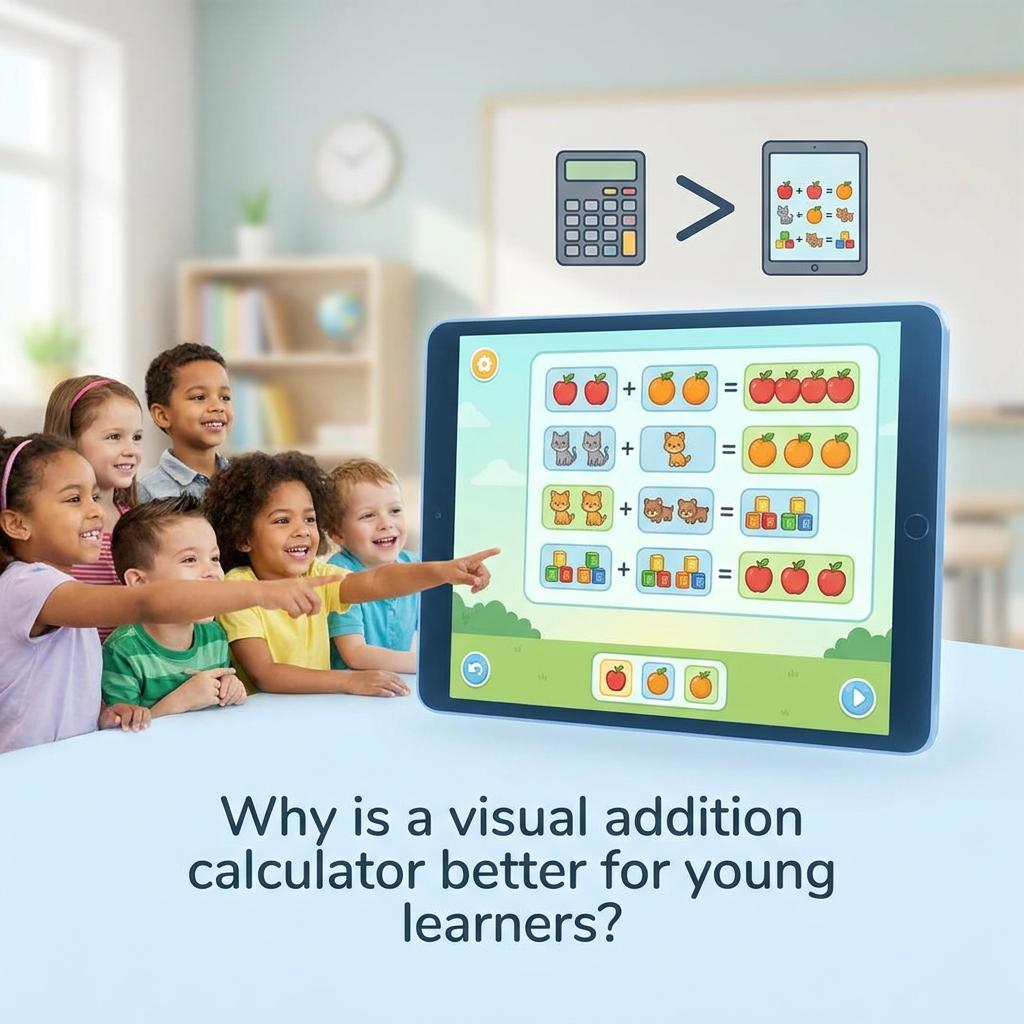
Visual learning has long been recognized as one of the most effective ways young children absorb new information, and mathematics is no exception. Children are naturally drawn to color, shape, movement, and pattern long before they are comfortable with abstract symbols like “+” and “=”. This is precisely why visual addition calculators have become increasingly popular visual learning tools in classrooms and homes around the world. Unlike a standard calculator that simply returns a number, a visual addition calculator shows the process — objects combining, counters growing, groups merging — so children can actually see what addition means.
This article explores exactly why visual representation matters so much for elementary math skills, how these tools build genuine number sense, and how parents and teachers can use them most effectively. Readers will learn how visual addition calculators work, the cognitive science behind why they’re so effective, how they compare to traditional and standard calculator methods, and practical strategies for using them at home and in the classroom — all aimed at helping young learners build a joyful, confident foundation in arithmetic learning.
Understanding Visual Addition Calculators
What Is a Visual Addition Calculator?
A visual addition calculator is a learning tool that helps children solve addition problems by showing the quantities involved through pictures, objects, counters, or other visual representations — rather than simply displaying a numeric result. Where a traditional calculator takes an input and produces an output with no visible process, a visual addition calculator makes the entire process transparent.
Definition and purpose
At its core, a visual addition calculator is designed to bridge the gap between concrete understanding and abstract symbol manipulation. Its purpose is not to replace thinking but to illustrate thinking — to give children a window into what is actually happening when two quantities combine into one larger quantity.
How it differs from a standard addition calculator
A standard calculator is built for speed and accuracy. A visual addition calculator is built for understanding. The standard tool assumes the user already grasps the concept of addition and simply needs a fast answer. The visual tool assumes the opposite — that the user is still building that conceptual foundation — and therefore prioritizes showing why the answer is what it is, not just what the answer is.
Common visual elements used
Most visual addition calculators rely on a combination of:
- Counters or tokens that can be grouped and combined
- Number lines showing movement from one quantity to a combined total
- Ten-frames that organize quantities into rows of ten for instant recognition
- Color-coded groupings that distinguish the two addends before they combine
- Animated merging of object groups to visually demonstrate the “joining” action of addition
How Visual Addition Calculators Work
Number visualization
Instead of typing “4 + 3” and seeing “7” appear instantly, a child using a visual addition calculator might see four colored dots appear, followed by three more dots in a different color, which then visually combine into a single group of seven. This transforms an abstract equation into an observable event.
Objects, counters, and representations
Many tools use familiar, relatable objects — apples, stars, blocks, animals — to make the abstract concept of “quantity” feel tangible. A child does not need to understand symbolic notation to count seven apples; they simply need to see and count.
Interactive learning methods
The best visual addition calculators are not passive displays — they are interactive. Children can often tap, drag, or arrange objects themselves, actively constructing the addition process rather than just watching it happen. This active participation deepens understanding far more than passive observation alone.
Why Young Learners Respond Better to Visual Learning
Brain development and visual processing
Young children’s brains are still developing the capacity for abstract symbolic reasoning, but their visual processing systems mature much earlier. This is a well-established pattern in early childhood cognitive development: children can recognize, sort, and compare visual quantities well before they can manipulate abstract numerals with confidence. Visual tools work with this natural developmental sequence rather than against it.
Learning through observation
Children are natural observers. Long before they can read or calculate, they are watching, noticing, and drawing conclusions from what they see. A visual addition calculator leverages this instinct, allowing children to learn addition the same way they learn so much else in early life — by watching something happen and making sense of it.
Connecting numbers to real-world objects
Numbers are abstractions. A “5” on a page has no inherent meaning to a young child until it is connected to something real — five fingers, five toys, five cookies. Visual addition calculators maintain this critical connection between symbol and reality far longer than traditional numeral-only instruction, which helps prevent the disconnect that causes so much early math confusion.
The Importance of Visual Learning in Early Mathematics
How Children Learn Mathematical Concepts
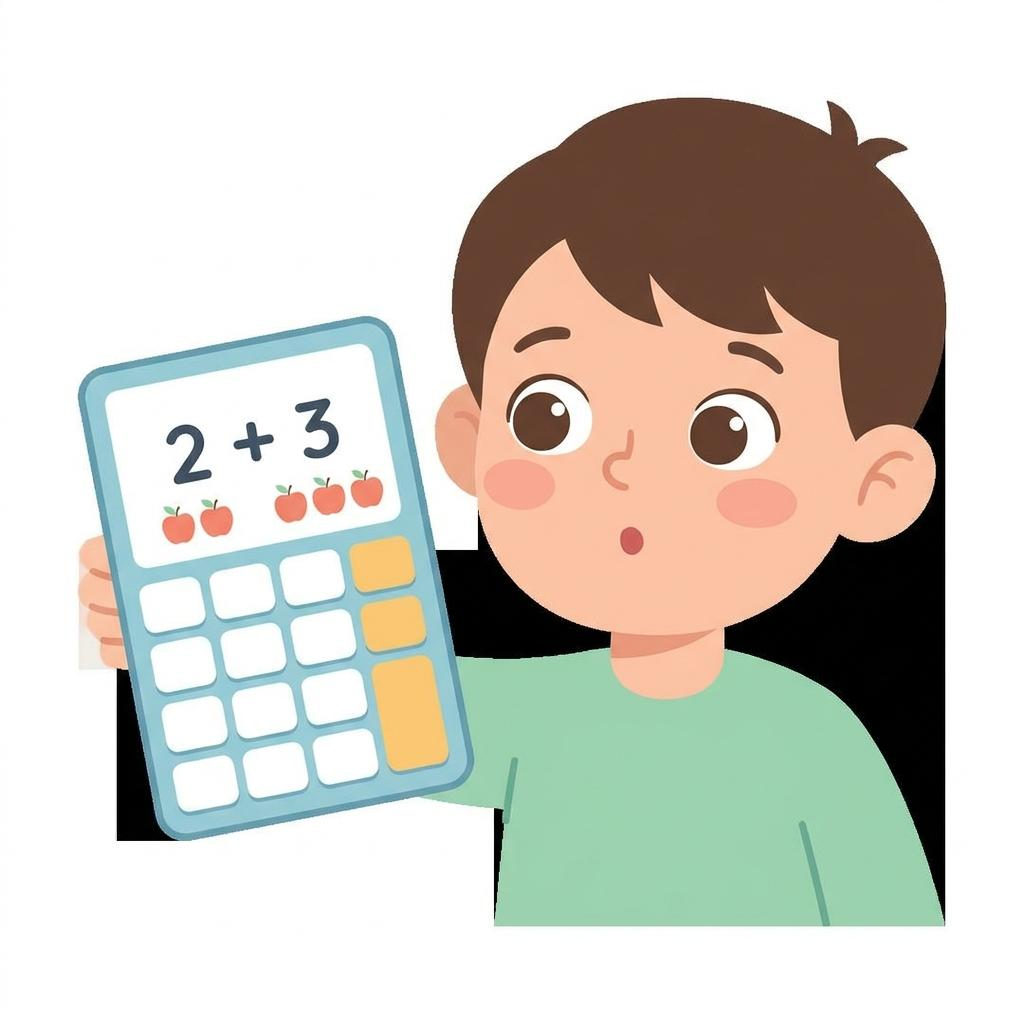
Mathematical understanding develops in a predictable progression, often described as moving from concrete experiences (physical objects) to pictorial representations (drawings and images) and finally to abstract symbols (numerals and equations). This progression is sometimes referred to as the Concrete-Pictorial-Abstract approach, and it forms the backbone of effective early math instruction worldwide.
Visual addition calculators sit precisely at the pictorial stage of this progression — and crucially, they also bridge backward toward concrete understanding and forward toward abstract fluency, all within a single tool. This makes them uniquely valuable across the full span of early elementary education.
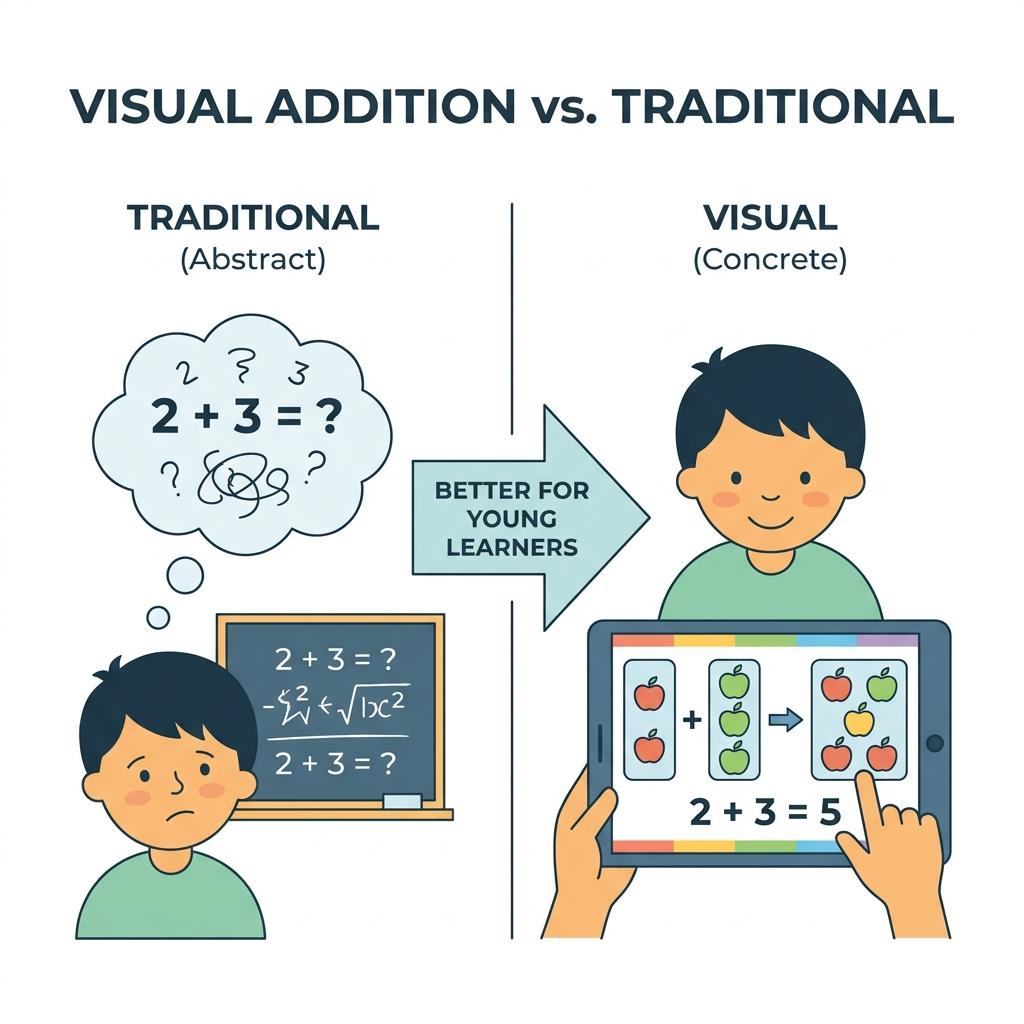
Visual Learning vs Traditional Learning Methods
Traditional math instruction has often relied heavily on memorization — flashcards, repeated drills, and worksheets filled with numerals. While repetition does have its place in building fluency, memorization without understanding can create a fragile kind of knowledge: children may recall that “4 + 3 = 7” without truly grasping why that is true.
Visual learning methods, by contrast, build understanding first and fluency second. A child who has watched and manipulated groups of four and three objects combining into seven has internalized the concept of addition, not just the fact. This conceptual foundation makes later math — including subtraction, multiplication, and word problems — significantly easier to grasp.
Building Strong Number Sense Through Visualization
Number sense refers to a child’s intuitive understanding of numbers, quantities, and their relationships — the ability to recognize that 8 is more than 5, that 10 is “a lot” compared to 2, and that numbers can be broken apart and recombined in different ways. Number sense is widely considered one of the strongest predictors of long-term mathematical success.
Visualization is one of the most powerful ways to build number sense, because it allows children to directly perceive these relationships rather than simply being told about them. Seeing eight objects next to five objects, and observing how much “more” eight is, builds an intuitive number sense that abstract numeral comparison alone often fails to achieve.
Understanding Quantity and Relationships Between Numbers
Visual addition calculators help children grasp not just individual quantities but the relationships between them — concepts like “more than,” “less than,” “equal to,” and “how many more are needed.” These relational concepts form the foundation for nearly all future mathematical reasoning, from basic comparison to algebraic thinking.
The Role of Colors, Shapes, and Interactive Elements
Color and shape are not just decorative features in visual addition tools — they serve real cognitive functions. Color-coding helps children track which objects belong to which addend before combination occurs. Distinct shapes help children practice counting and categorization simultaneously. Interactive elements — tapping, dragging, animating — engage motor memory alongside visual memory, creating multiple pathways for the same concept to take root in a child’s understanding.
Benefits of Visual Addition Calculators for Young Learners
Faster Understanding of Addition Concepts
Because visual tools make the addition process observable rather than abstract, children typically grasp the underlying concept more quickly than with numeral-only instruction. Seeing two groups merge into one larger group communicates the essence of addition almost instantly, in a way that reading “2 + 3 = 5” on a worksheet often does not.
Improved Number Recognition Skills
Repeated exposure to visually represented quantities strengthens a child’s ability to recognize numbers at a glance — a skill known as subitizing. Children who can instantly recognize small quantities without counting one-by-one develop faster, more confident arithmetic skills overall.
Better Retention and Memory Development
Information learned through multiple sensory channels — visual, sometimes tactile, sometimes auditory — tends to be retained longer than information learned through a single channel. Visual addition calculators naturally engage multiple memory pathways, supporting better retention of foundational addition facts.
Increased Classroom Engagement
Bright colors, interactive elements, and game-like presentation naturally capture young children’s attention more effectively than static worksheets. This increased engagement translates directly into more focused, productive learning time.
Reduced Math Anxiety
Math anxiety can begin remarkably early, often as a result of repeated experiences of confusion or failure with abstract numerals. Visual tools reduce this anxiety by making math feel approachable, concrete, and even playful — removing the intimidation factor that abstract symbols can carry for young children.
Higher Learning Confidence
When children can see that their answer makes sense — because they watched the objects combine — they develop genuine confidence in their mathematical ability. This confidence is self-reinforcing: children who feel capable in math are more willing to attempt challenging problems and persist through difficulty.
Improved Problem-Solving Skills
Visual representation encourages children to think flexibly about quantities — breaking them apart, regrouping them, and approaching problems from multiple angles. This flexible thinking is a core component of strong problem-solving skills that extends well beyond simple addition.
Encouragement of Independent Learning
Because visual addition calculators make the process self-evident, children often need less direct adult guidance to understand what is happening. This supports independent learning, allowing children to explore and practice on their own while still building genuine understanding.
Support for Different Learning Styles
Not every child learns the same way. Visual addition calculators are particularly valuable because they accommodate visual learners directly, while their interactive features also support kinesthetic learners and their guided narration (in many digital tools) supports auditory learners as well.
Better Focus and Attention Span
The engaging, dynamic nature of visual tools tends to hold young children’s attention longer than static, text-heavy materials. Sustained attention during practice sessions translates into more meaningful repetition and stronger skill development over time.
How Visual Addition Calculators Improve Math Fluency
Repetition and Reinforcement
Math fluency — the ability to recall and apply arithmetic facts quickly and accurately — depends heavily on meaningful repetition. Visual addition calculators make repeated practice feel engaging rather than tedious, encouraging children to willingly repeat exercises that reinforce foundational facts.
Developing Faster Mental Calculations
As children repeatedly observe visual representations of the same number combinations, they gradually internalize these patterns, eventually being able to recall them mentally without needing the visual support at all. This is the natural and healthy progression from visual dependence to mental fluency.
Pattern Recognition in Numbers
Visual tools make numerical patterns — such as doubles, near-doubles, and combinations that make ten — much easier to notice and internalize. A child who visually sees that 5 + 5 and 6 + 4 both result in groups of ten begins to recognize these patterns intuitively, a skill that dramatically speeds up later mental arithmetic.
Strengthening Basic Arithmetic Foundations
Because visual tools build genuine conceptual understanding rather than rote memorization alone, the basic arithmetic foundations they establish tend to be more resilient and transferable to new, unfamiliar problems — rather than fragile knowledge limited to memorized fact pairs.
Supporting Long-Term Mathematical Success
The conceptual depth built through early visual learning continues to pay dividends well beyond addition itself. Children with strong early number sense and conceptual understanding consistently show stronger performance in later mathematical topics, including multiplication, fractions, and early algebraic reasoning.
How Visual Addition Calculators Help Different Types of Learners
Visual Learners
For children who naturally process and retain information best through sight, visual addition calculators are an almost perfect match — translating abstract numerical concepts directly into the format these learners absorb most readily.
Kinesthetic Learners
Interactive visual tools that allow dragging, tapping, and arranging objects engage kinesthetic learners, who benefit from physical interaction and movement as part of the learning process, even within a digital environment.
Auditory Learners
Many visual addition calculators include narration or sound feedback alongside the visual display, giving auditory learners an additional channel through which to absorb and reinforce the same mathematical concept.
Students with Learning Difficulties
For children with learning difficulties, particularly those affecting working memory or abstract symbolic processing, visual representation can make mathematical concepts accessible in ways that purely numeral-based instruction cannot. The concrete, observable nature of visual tools reduces the cognitive load required to grasp new concepts.
Children with Attention Challenges
Engaging, colorful, interactive visual tools tend to hold the attention of children with shorter attention spans more effectively than static worksheets, allowing for more productive and sustained practice sessions.
Special Education Applications
Visual addition calculators are increasingly used in special education settings precisely because they reduce reliance on abstract symbolic reasoning and instead emphasize observable, concrete representations — making math more accessible to a wider range of learning profiles and needs.
Role of Visual Addition Calculators in Modern Classrooms
Integration Into Digital Learning
As classrooms increasingly incorporate digital tools, visual addition calculators fit naturally into broader digital learning ecosystems, often integrated alongside interactive whiteboards, tablets, and classroom learning software.
Classroom Activities and Exercises
Teachers can use visual addition calculators for whole-class demonstrations, small-group rotations, or individual practice stations — making them flexible enough to fit nearly any classroom structure or lesson plan.
Teacher-Guided Learning
When used under teacher guidance, visual addition calculators become powerful instructional aids — teachers can pause, ask questions, and prompt discussion at key moments in the visual process, deepening conceptual understanding far beyond what the tool alone could achieve.
Group Learning Benefits
Visual tools naturally lend themselves to group discussion, since multiple children can observe the same visual representation simultaneously and discuss what they see, compare predictions, and reason together about the result.
Homework and Independent Practice
Because visual addition calculators are largely self-explanatory, they are well-suited to independent homework practice, allowing children to reinforce classroom learning at home with minimal need for parental math expertise.
Visual Addition Calculators for Homeschooling
Benefits for Parents
For homeschooling parents, visual addition calculators offer enormous value — they reduce the burden of explaining abstract mathematical concepts from scratch and instead provide a ready-made, engaging visual framework that does much of the conceptual heavy lifting.
Flexible Learning Approaches
Homeschool environments benefit from the flexibility visual tools provide — lessons can be paused, repeated, slowed down, or sped up entirely according to the individual child’s pace, something far harder to achieve in a traditional classroom setting.
Tracking Student Progress
Many visual addition calculators include built-in progress tracking, helping homeschooling parents monitor exactly which concepts and number combinations their child has mastered and which still require additional practice.
Making Learning Fun at Home
The colorful, game-like nature of visual addition tools helps transform math practice from a chore into an enjoyable activity, which is particularly valuable in home settings where maintaining a child’s motivation can be more challenging without classroom peer dynamics.
Age-Based Benefits
Preschool Learners
For preschoolers, visual addition calculators introduce the earliest seeds of mathematical thinking — quantity recognition, simple combination, and the beginning of one-to-one correspondence — all without requiring any prior knowledge of numerals or symbols.
Kindergarten Students
Kindergarteners benefit from visual tools that bridge their growing familiarity with numerals to the concrete quantities those numerals represent, reinforcing the critical connection between symbol and meaning.
Grade 1 Students
In grade 1, as children begin formal addition instruction, visual addition calculators provide essential scaffolding, helping new concepts like “carrying” or combining two-digit numbers feel concrete and understandable rather than purely procedural.
Grade 2 Students
By grade 2, children can use visual tools to explore more complex addition, including double-digit and triple-digit combinations, while continuing to reinforce the conceptual understanding established in earlier grades.
Transitioning Toward More Advanced Arithmetic
As children grow more confident, visual addition calculators naturally support the transition toward more abstract, symbol-based arithmetic — having built the conceptual foundation needed to make that transition smooth and lasting rather than confusing or superficial.
Comparing Visual Addition Calculators With Traditional Methods
| Factor | Visual Addition Calculators | Traditional Learning Methods |
|---|---|---|
| Learning Speed | Faster initial conceptual grasp due to observable, concrete representation | Slower initial understanding; relies heavily on abstract symbol comprehension |
| Concept Understanding | Deep and intuitive, built through direct observation of quantities combining | Often surface-level initially; understanding develops gradually through repetition |
| Student Engagement | High — colorful, interactive, and inherently motivating for young children | Variable — worksheets and drills can feel repetitive and less engaging |
| Retention Rate | Strong, due to multi-sensory and conceptual learning pathways | Moderate, particularly when based primarily on memorization |
| Confidence Building | High — children see their reasoning confirmed visually in real time | Slower to build; confidence often depends on accumulated correct answers over time |
| Independent Learning | Strongly supported — visual tools are largely self-explanatory | Often requires more direct adult or teacher guidance |
| Error Reduction | Lower error rates, as visual feedback helps children self-correct | Higher error rates possible when symbolic understanding is incomplete |
Visual Addition Calculators vs Standard Calculators
| Factor | Visual Addition Calculators | Standard Calculators |
|---|---|---|
| Educational Value | High — designed specifically to teach and reinforce understanding | Low for beginners — designed for speed and accuracy, not learning |
| Concept Development | Strong — actively builds conceptual understanding of addition | Minimal — provides answers without explaining the underlying process |
| Visualization Support | Core feature — quantities and combinations are shown explicitly | Absent — only numerical input and output are displayed |
| Learning Retention | Strong, due to engagement with the conceptual process | Weak — answers are not internalized without understanding |
| Student Motivation | High — interactive, colorful, and engaging for young children | Low for young learners — purely functional and unengaging |
| Ease of Understanding | Very accessible — designed specifically for early learners | Difficult for beginners who lack foundational number understanding |
Common Mistakes Parents and Teachers Make
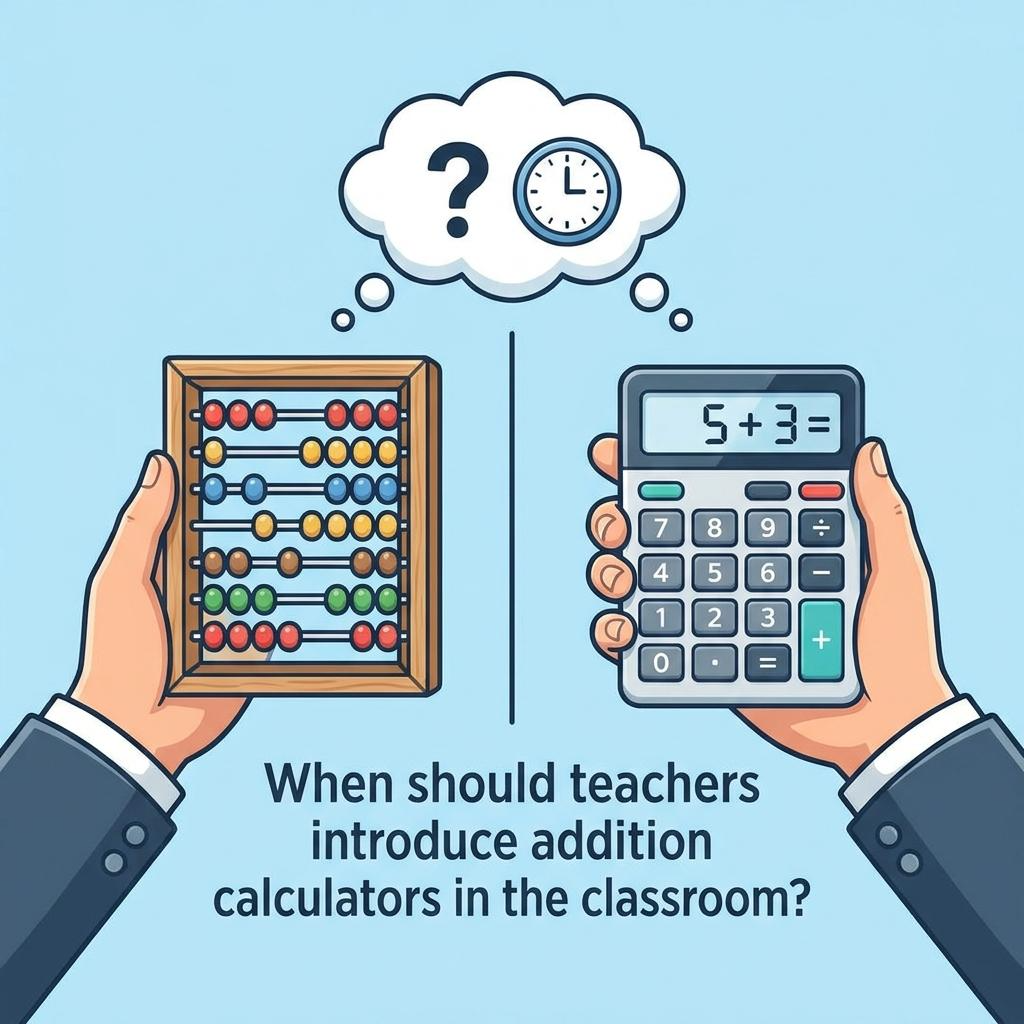
Introducing Calculators Too Early
One of the most common mistakes is introducing standard (non-visual) calculators before children have developed sufficient conceptual understanding. This can encourage children to seek answers without understanding the reasoning behind them. Visual addition calculators help avoid this pitfall precisely because they teach understanding rather than bypassing it.
Overdependence on Technology
Even visual tools can become a crutch if used without balance. Children need continued opportunities to practice without any tool at all, gradually building independent mental fluency rather than relying indefinitely on visual or digital support.
Ignoring Mental Math Practice
Visual tools are most effective when paired with ongoing mental math practice. Skipping this step can leave children dependent on visual aids longer than necessary, delaying the natural progression toward abstract fluency.
Lack of Guided Learning
Visual addition calculators are powerful, but they are most effective when paired with adult guidance — questions, discussion, and prompts that deepen understanding beyond what passive use of the tool alone can achieve.
Failing to Track Progress
Without regular monitoring, it can be difficult to know whether a child is genuinely progressing toward independent fluency or simply becoming comfortable with the visual tool itself. Consistent, simple progress checks help ensure real growth is occurring.
Best Practices for Using Visual Addition Calculators
Combining Visual Tools With Traditional Learning
The most effective approach blends visual addition calculators with traditional practice — worksheets, oral drills, and written exercises — ensuring children build both conceptual understanding and procedural fluency.
Creating Daily Practice Routines
Short, consistent daily practice sessions — even just five to ten minutes — tend to produce far stronger long-term results than infrequent, longer sessions. Regularity matters more than duration at this stage.
Setting Learning Goals
Clear, achievable goals — such as mastering all addition facts up to ten before progressing further — give both children and adults a sense of structure and accomplishment throughout the learning process.
Encouraging Mental Math Alongside Visual Learning
Periodically asking children to predict an answer before using the visual tool encourages the gradual development of mental math skills alongside continued visual reinforcement.
Measuring Student Improvement
Simple, regular check-ins — brief oral quizzes, informal observation, or built-in tool tracking features — help parents and teachers identify exactly where a child stands and what to focus on next.
Advanced Educational Insights
Cognitive Science Behind Visual Learning
Cognitive development research consistently shows that young children process and retain visual information more readily than abstract symbolic information. This is not a matter of preference but of developmental timing — the brain systems responsible for visual-spatial processing mature earlier than those responsible for abstract symbolic reasoning, making visual learning developmentally well-matched to early childhood.
Why Visualization Accelerates Learning
Visualization accelerates learning by reducing the cognitive distance between a concept and its representation. When a child sees five objects and three objects combine into eight, there is no symbolic translation required — the meaning is directly observable, which dramatically reduces the mental effort needed to grasp the concept.
The Connection Between Visual Memory and Mathematics
Visual memory plays a significant role in mathematical reasoning, particularly in early arithmetic. Children who can visually recall quantity groupings — such as instantly picturing what “six” looks like as a group — develop faster, more intuitive number sense than those relying solely on memorized numeral facts.
Research-Based Benefits of Interactive Learning
Interactive learning experiences, where children actively manipulate representations rather than passively observing them, consistently show stronger engagement and retention outcomes than passive instructional methods. This is a key reason why the interactive nature of visual addition calculators matters as much as their visual nature.
Future of Visual Learning Technology in Education
As educational technology continues to evolve, visual learning tools are likely to become increasingly adaptive — responding to individual children’s pace, identifying specific areas of difficulty, and personalizing visual representations accordingly. This points toward a future where early math education becomes even more individualized and effective.
Practical Tips for Parents
Making Addition Practice Enjoyable
Frame practice sessions as games rather than lessons. Celebrate small wins enthusiastically, and avoid turning mistakes into moments of frustration — keeping the emotional tone of math practice positive is just as important as the content itself.
Building Consistent Learning Habits
Choose a consistent time each day for practice, even briefly. Predictability helps children know what to expect and reduces resistance to starting practice sessions.
Reward Systems and Motivation
Simple reward systems — stickers, praise, small privileges — can help maintain motivation, particularly in the early stages of building a regular practice habit.
Tracking Improvement Over Time
Keep a simple record of which number combinations your child has mastered. Watching this list grow can be motivating for both parent and child alike.
Practical Tips for Teachers
Classroom Implementation Strategies
Introduce visual addition calculators during whole-group instruction first, modeling their use clearly, before transitioning to independent or small-group practice once students understand the basic interaction.
Student Assessment Methods
Combine informal observation of visual tool use with brief, regular oral or written checks to get a complete picture of each student’s developing fluency.
Creating Interactive Lessons
Build lessons around prediction and discussion — asking students to guess the outcome before revealing it visually keeps engagement and critical thinking high throughout the lesson.
Encouraging Participation
Use visual tools in group settings where students can take turns manipulating the representation, keeping every child actively engaged rather than passively watching.
Real-Life Applications of Strong Addition Skills
Everyday Money Calculations
Strong addition skills are essential for handling money — adding up prices, calculating change, and understanding basic financial transactions, skills children will use throughout their entire lives.
Shopping and Budgeting
As children grow, addition skills become essential for budgeting and shopping decisions, helping them understand value, cost, and basic financial planning.
Time Management
Addition underlies many everyday time calculations — figuring out how much time has passed, how long an activity will take, or what time an event will end.
Academic Success
A strong foundation in addition directly supports success in nearly every subsequent area of mathematics, from multiplication tables to algebraic equations, making early mastery a critical academic investment.
Future Career Benefits
Quantitative reasoning skills, rooted in early arithmetic fluency, remain valuable across countless career paths — from everyday financial literacy to professions requiring more advanced mathematical reasoning.
Frequently Asked Questions (FAQs)
1. What is a visual addition calculator?
A visual addition calculator is an educational tool that helps children understand and solve addition problems by displaying the process visually — using counters, objects, color-coded groups, number lines, or other graphical representations — rather than simply providing a numeric answer. Its primary purpose is to make the concept of addition observable and understandable, not just to produce a fast result. This makes it especially valuable for young learners who are still developing the abstract reasoning skills needed to work with numbers alone.
2. How does a visual addition calculator help young children learn addition?
Visual addition calculators help by transforming an abstract mathematical operation into something children can directly observe and interact with. When a child watches two groups of objects combine into one larger group, they build an intuitive understanding of what addition actually means — rather than simply memorizing that certain number pairs produce certain results. This conceptual understanding makes it easier for children to apply addition flexibly to new, unfamiliar problems, rather than only recalling memorized facts.
3. At what age should children start using visual addition calculators?
Children can begin benefiting from visual addition tools as early as preschool, when basic quantity recognition and counting skills are first developing. The complexity of the tool should grow alongside the child — simple object-counting visuals for preschoolers and kindergarteners, progressing toward number lines and ten-frame representations for grade 1 and grade 2 students as they move toward more abstract arithmetic. The key is matching the tool’s complexity to the child’s current developmental stage rather than focusing strictly on age alone.
4. Can visual addition calculators improve math fluency?
Yes. While visual addition calculators are primarily designed to build conceptual understanding, this understanding is actually the foundation of genuine fluency. Children who deeply understand why addition works are able to recall and apply facts more reliably and flexibly than those who have only memorized them. Over time, repeated use of visual tools, paired with mental math practice, naturally supports the transition toward fast, confident, independent calculation.
5. Are visual addition calculators better than traditional teaching methods?
Rather than being a wholesale replacement, visual addition calculators are best understood as a powerful complement to traditional teaching methods. They excel at building initial conceptual understanding and engagement, particularly for young or struggling learners, while traditional methods — including repetition, written practice, and mental math drills — remain essential for building lasting fluency. The most effective approach combines both, using visual tools to establish genuine understanding and traditional practice to reinforce and solidify that understanding into lasting skill.
Conclusion
Visual learning is not simply a passing educational trend — it reflects how young children’s brains are naturally wired to process and absorb new information. Visual addition calculators harness this natural tendency, transforming an abstract mathematical operation into something children can see, interact with, and genuinely understand. By making addition observable rather than purely symbolic, these tools help young learners build the kind of deep, intuitive number sense that forms the foundation for all future mathematical success.
For students, the benefits are substantial: faster initial understanding, stronger retention, increased confidence, reduced math anxiety, and support for a wide range of learning styles and needs. For parents, especially those navigating homeschooling, visual addition calculators offer an accessible, engaging way to support a child’s mathematical development without requiring specialized teaching expertise. For teachers, these tools provide flexible, adaptable resources that fit seamlessly into whole-class instruction, small-group work, and independent practice alike.
As educational technology continues to advance, the potential for visual learning tools to become even more responsive, personalized, and effective will only continue to grow — offering future generations of young learners even richer, more individualized paths toward mathematical confidence and competence.
Ultimately, the goal of any early math tool should be to nurture not just correct answers, but genuine understanding and a lasting sense of curiosity and confidence around numbers. Visual addition calculators, used thoughtfully and in balance with traditional practice, offer exactly that — a joyful, accessible bridge into a lifetime of mathematical thinking. Every child who learns to see addition before they memorize it is building a foundation strong enough to support everything that comes next.

Author: Toolz Daily
Official Account Of Website Owner..